 AFCON 2025



Roger Milla, the first thing that comes to mind when you mention that name in the circles of those who watched football, especially the 1990 FIFA World Cup in Italy, is his famous corner flag dance, which remains, arguably most iconic and memorable highlight of the tournament where Cameroon etched their name into history.
Roger Milla’s iconic dance has remained relevant to date as it often appears in FIFA World Cup promotions, adverts, show reels, and documentaries, among other digital materials. But there is more to the global football icon than his dance steps at the World Cup.
Roger Milla is arguably the most talented African player to ever play the game. He defied the odds at the age of 38 to lead Cameroon to a historic appearance at the 1990 World Cup, where the Indomitable Lions became the first African team to play in the quarter-finals of the FIFA World Cup.
En route to their quarter-final feat, Roger Milla scored four goals and celebrated each of them at the corner flag with dance steps similar to the popular Makossa. Milla’s dance steps changed the way the World saw African football, and his celebrations created positive energy among fans in the stadium.

Roger Milla featured at the 1984, 1986, and 1988 Africa Cup of Nations and three FIFA World Cup tournaments: 1982, 1990, and 1994, where he holds the record as the oldest goal scorer in the history of the competition at the age of 42.
The Cameroonian forward spent most of his club career in France, where he played for six clubs between 1977 and 1990 before making a final stop at Petila Jaya and Putra Samarinda, subsequently in the Indonesian League.
This post traces the early beginnings of Roger Milla’s life before he became a global football icon, detailing his background and then career, achievements, family, legacy, and other endeavours after football.
Roger Milla Background
Albert Roger Miller was born to a middle-class family in Yaounde, the capital of Cameroon, on the 20th of May 1952. Roger Milla has three brothers —Joseph Debouba, Jacques Edjanque, and Alexandre Diboussi, each with a different surname. He grew up in the streets of Yaounde, kicking about whatever looked like a round object in place of a football. Like the average African parents, Roger Millas wanted their son to become either a doctor, an engineer, a lawyer, or one of the other popular professions, but they were disappointed that their son loved football and were reluctant to give approval initially, as expected.
His love for football began in the humble streets of Cameroon, where he honed his skills barefoot alongside other kids, kicking makeshift balls like oranges, tin cans, lemons, or rags bundled together. Without proper soccer academies, well-kept fields, or certified coaches, Young Roger Milla played on dusty pitches, turning playtime into pure joy and adventure. For him, the game was all about fun—he never dreamed of turning pro and only sharpened his talents during school breaks.
Roger Milla claimed to have finished high school, but Cameroonian writers have disputed that. He came close to quitting the sport after his mother’s sudden death at home while he was away playing in a far-off match, compounded by his wife’s pregnancy with their second child.
Career Beginnings
Roger Milla started his football journey at the age of 13. He joined the junior team of Eclair de Douala in Cameroon, focusing on school tournaments. His standout performances in youth matches eventually won over his parents, paving the way for his rise. He made waves in the senior team for Eclair in Cameroon’s second division at the age of 15, and two years later, he claimed the national schools high jump championship, showing his all-around athletic talent.
In 1970, Roger Milla signed with top-tier club Léopard Douala, where he impressed greatly, helping them clinch three Cameroonian championships over four years while scoring an impressive 89 goals in 116 games. Four years later, Roger Milla switched to Tonnerre Yaoundé and led them to victory in the African Cup Winners’ Cup and scoring 69 goals in 87 matches. His success caught the attention of several European clubs, and at 25, he made the big career move to France in 1977.
Move to France
Roger Milla spent twelve years playing for several clubs in France. He started with Valenciennes, bagging 6 goals in 28 league games over two seasons. Roger Milla joined AS Monaco in 1979, where he lifted the 1980 French Cup despite injury setbacks, scoring 5 goals in 25 appearances before being released.
Disappointed but undeterred, he shone brightly at Bastia for four seasons, with 42 goals in 133 competitive matches and playing a key role in their 1981 French Cup win. In 1984, Roger Milla joined Saint-Étienne, where he arguably had his best moment in France. He joined the club after a bribery scandal and relegation and became a vital force, scoring 36 goals in 69 games and helping them bounce back to the first division.
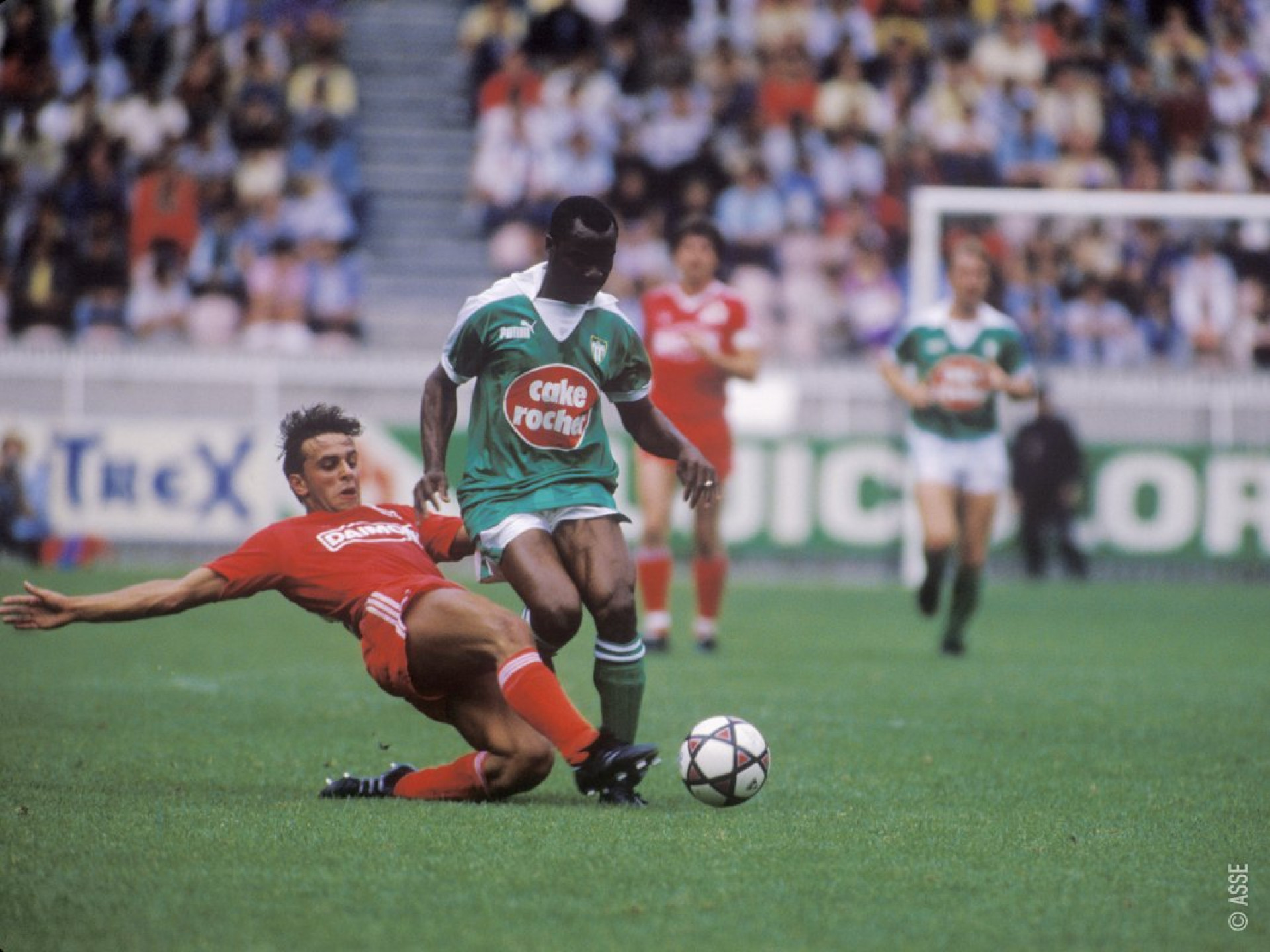
Roger Milla played for Montpellier between 1986 to 1989, netting 41 goals in 103 appearances— including 18 in his debut season that secured promotion. Later, he even returned to the club as part of the coaching staff.
Roger Milla played for Réunion to play for JS Saint-Pierroise before bidding farewell to French football in 1990, aged 37. His iconic World Cup exploits brought him back home to Tonnerre for four more seasons.
After the 1994 World Cup, Roger Milla ended his career in Indonesia with two clubs, retiring in 1996 after an astonishing run of 41 goals in just 35 matches.
Roger Milla and Cameroon
Roger Milla’s journey with the Cameroonian national team is nothing short of legendary. He earned 77 caps and scored 43 goals, making him the country’s third all-time top scorer behind Samuel Eto’o and Vincent Abubakar. He started his international career in 1973 with a World Cup qualifier against Zaire, and his first World Cup appearance came in 1982, marking Cameroon’s debut in the tournament.
Roger Milla played a crucial role in helping his country qualify, finishing as the top scorer in the African Zone qualifiers. Unfortunately, Cameroon exited the tournament with three draws. Milla’s disallowed goal against Peru was a moment of heartbreak. He went on to represent Cameroon at the 1984 Summer Olympics in Los Angeles two years later.
In 1984, he helped Cameroon win its first African Cup of Nations title as the Indomitable Lions defeated the Super Eagles of Nigeria 3–1 in the final. Roger Milla continued to shine in the 1986 edition, where Cameroon finished second behind Egypt, but he emerged as the tournament’s top scorer with four goals and was also named best player. In 1988, he once again proved his worth, finishing as joint top scorer and leading Cameroon to another AFCON victory. Roger Milla’s performances earned him the player of the tournament award and a spot in the tournament’s best eleven.
/cdn.vox-cdn.com/uploads/chorus_asset/file/10150161/52935046.jpg.jpg)
Roger Milla retired from international football in 1988, aged 36, celebrating his career with a send-off match in Douala, Cameroon, but fate had other plans. In 1990, President Paul Biya personally called Milla, urging him to return for the World Cup in Italy. The president had seen Milla score twice in a charity match and believed he still had magic to offer.
Despite resistance from the national coach, Valery Nepomnyashchy, and some teammates, Biya issued a presidential decree compelling Milla’s inclusion. Fans and sportswriters, still madly and deeply in love with their legend, supported the decision, especially after Cameroon’s disappointing performance at the 1990 AFCON, where they were eliminated in the group stage.
Roger Milla’s return was nothing short of miraculous. At 38, he became a global sensation at the 1990 World Cup in Italy, scoring unforgettable goals and celebrating with his iconic corner-flag dance.
Rogger Milla’s World Cup Heroics
Roger Milla didn’t start a single match at the 1990 FIFA World Cup; he was the spotlight of the tournament, arguably. At 38, he came off the bench in every game, often in the second half, and scored all four of his goals as a substitute. Milla’s most dramatic moment came against Romania, when he netted two goals in extra time within just two minutes, securing Cameroon’s place in the knockout rounds. That performance turned Roger Milla into a national hero overnight. Coach Valery Nepomnyashchy, who had already seen Milla’s impact in the upset win over reigning champions Argentina, put his trust in the legend as he brought him on earlier in the Romania match, fully aware of what was at stake.
Despite being the oldest outfield player in the tournament—second only to England’s goalkeeper Peter Shilton—Milla lit up Italy with his energy and flair. His four goals, each followed by his now-iconic dance at the corner flag, made him one of the breakout stars of the tournament against all odds. Two of those goals came against Colombia in the Round of 16, propelling Cameroon to the quarter-finals—the first African team to achieve the feat.

In the quarter-final against England, Roger Milla came on with Cameroon trailing 1–0, won a penalty, and assisted a goal that gave his team a 2–1 lead. Milla’s impact was undeniable, even though England eventually won 3–2 in extra time, courtesy of two penalty kick goals by Gary Lineker. Roger Milla’s outstanding performances earned him the African Footballer of the Year award once again.
Roger Milla’s joyful celebration after scoring against Colombia became a global symbol of football’s spirit and was even featured in Coca-Cola’s 2010 World Cup campaign. But Milla wasn’t done with football just yet. He featured for Cameroon at the 1994 World Cup in the United States at age 42, becoming the oldest player ever to appear in the tournament at the time.
Cameroon crashed out in the group stage, but Roger Milla didn’t leave the tournament without making history. He scored against Russia, setting a new record as the oldest goalscorer in World Cup history—a record he had already held since 1990. Roger Milla finally retired from football in a friendly against South Africa in December 1994, closing the curtain on one of the most inspiring careers in football history.
Career Achievements
Player
Léopards Douala
- Cameroon Première Division: 1971–72, 1972–73, 1973–74
Tonnerre Yaoundé
- African Cup Winners’ Cup: 1975
- Cameroonian Cup: 1991
Monaco
- Coupe de France: 1979–80
Bastia
- Coupe de France: 1980–81
Montpellier
- Division 2: 1986–87
Cameroon
- African Cup of Nations: 1984[68], 1988[69]; runner-up, 1986
- Afro-Asian Cup of Nations: 1985
Individual
- African Footballer of the Year: 1976, 1990
- Africa Cup of Nations best player: 1986, 1988
- Africa Cup of Nations top scorer: 1986, 1988
- FIFA World Cup Bronze Boot: 1990
- FIFA World Cup All-Star Team: 1990
- FIFA 100
- CAF Best African Player of the last 50 years: 2007
- Golden Foot Legends Award: 2014
- IFFHS Legends
- World Soccer: The 100 Greatest Footballers of All Time
- CAF Golden Jubilee #1 Best Player
Orders
- Knight of the Legion of Honour: 2006
Life after Football
After retiring from playing, Roger Milla transitioned into coaching, leading Montpellier from 2001 to 2007 and later managing Tonnerre Yaoundé between 2007 and 2011. Roger Milla also ventured into football administration as he was appointed honorary president of the Cameroonian Football Federation in 2008. However, his tenure ended in 2012 after he publicly criticized the federation’s handling of a ban on fellow Cameroonian star Samuel Eto’o, a move that stirred controversy and led to his removal.
Roger Milla has continued to make an impact far beyond the football pitch. The football legend ambassador for African causes, he dedicates his time to volunteering with organizations like the World Wide Fund for Nature and has launched two companies focused on recycling plastic into paving slabs—blending environmental advocacy with entrepreneurship. His legacy as a football icon was cemented in 2004 when Pelé named him to the FIFA 100, a prestigious list celebrating the greatest living footballers.
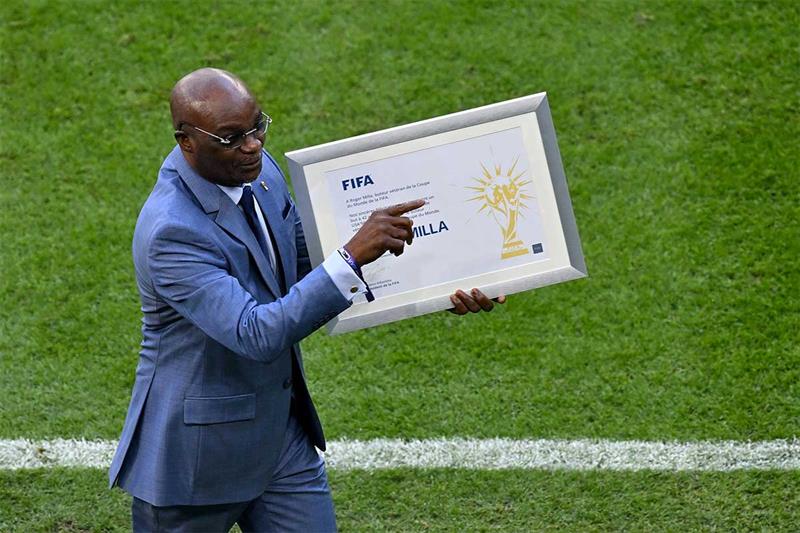
In 2022, FIFA formally recognized Milla’s contributions to the sport. FIFA President Gianni Infantino presented him with a commemorative plaque and invited him as a special guest at Cameroon’s World Cup match against Switzerland.
Roger Milla’s joyful Makossa-inspired corner flag dance from the 1990 World Cup remains iconic, symbolizing a shift in global perceptions of African football.