 AFCON 2025


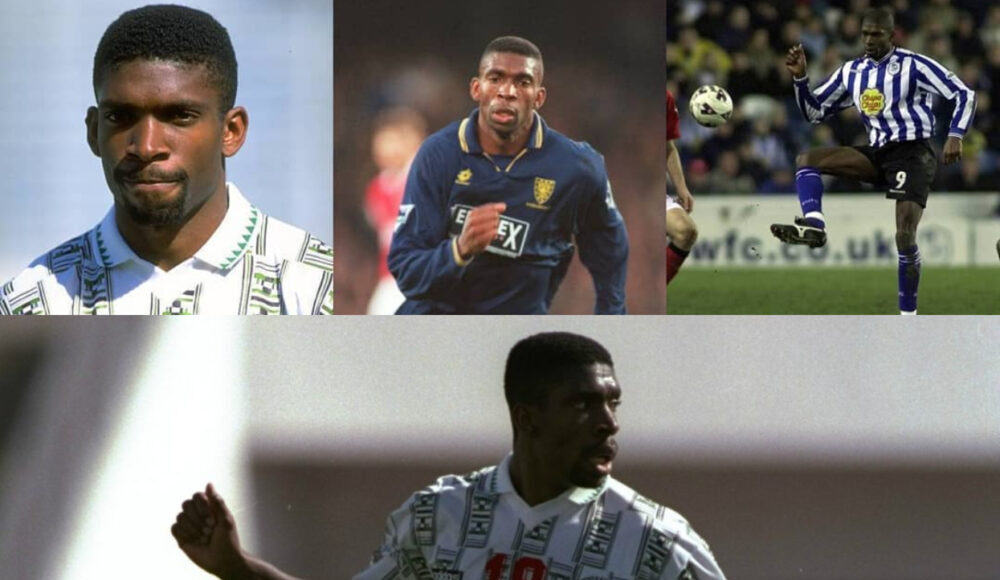
Efan Ekoku, born Efangwu Goziem Ekoku on June 8, 1967, in Manchester, England, is a former footballer, a pioneering Nigerian striker, and respected sports commentator.
Known for his powerful presence on the pitch and performances in the English Premier League, Ekoku’s journey from non-league football to international stardom is a story worth telling.
Efan Ekoku: Early Life and Nigerian Roots
Born in Cheetham Hill, Manchester, to Nigerian parents from Ika, Delta State, Efan Ekoku grew up in a family where athleticism ran deep. His brother Abi Ekoku was a British discus champion and professional rugby league player for the London Crusaders (now Bradford Bulls), while another brother, Nko, carved out a successful career in non-league football with clubs like Harrow Borough and Sutton United.
Their nephew, Danny, also pursued football, playing for Bradford City in the 2004–05 season. This sporting lineage shaped Ekoku’s competitive spirit from a young age.
Ekoku’s passion for football was evident early on. Starting at Merton FC and later Sutton United in non-league football, he honed his skills outside the professional spotlight. His raw talent as a striker—marked by physicality, speed, and a knack for finding the net—caught attention, setting the stage for his leap into professional football.
Breaking Into the Football League
Ekoku’s professional career kicked off in 1990 when he signed for AFC Bournemouth, then managed by Harry Redknapp and relegated to the Third Division.
His first season (1990–91) was modest, with just three goals in 20 games for a mid-table Cherries side. However, he found his stride in 1991–92, scoring 11 goals in 28 league matches, showcasing his potential as a clinical finisher. By the 1992–93 season, he added seven goals in 14 games, catching the eye of higher-tier clubs.
His performances earned him a £500,000 move to Norwich City in March 1993, thrusting him into the Premier League during its inaugural years.
Norwich City: Making History in the Premier League
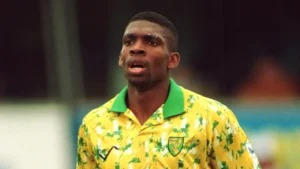
Ekoku arrived at Norwich City’s Carrow Road under manager Mike Walker, with the Canaries in the thick of the 1993–94 Premier League title race. He scored three goals in ten games that season, helping Norwich secure a third-place finish and UEFA Cup qualification, though they fell short of the title to Manchester United.
Ekoku’s impact was immediate, and he became a fan favorite for his work rate and goal-scoring prowess.
The 1993–94 season cemented Ekoku’s place in football history.
On September 15, 1993, he scored Norwich’s first-ever goal in European competition against Vitesse Arnhem in the UEFA Cup, a milestone in the club’s journey. Ten days later, he made headlines again, scoring four goals in a 5–1 thrashing of Everton at Goodison Park—the first time a player scored more than three goals in a Premier League match.
This record-setting performance, highlighted by a 44th-minute equalizer followed by three rapid second-half strikes, showcased his lethal finishing. Ekoku finished the season with 12 league goals in 27 games, totaling 14 across all competitions.
Despite a mid-season dip after Walker’s departure to Everton, which saw Norwich finish 12th, Ekoku’s contributions were unforgettable. In 2012, his legacy was honored with induction into the Norwich City Hall of Fame.
Wimbledon and Beyond: A Journeyman’s Career
In October 1994, Ekoku moved to Wimbledon for £1 million, replacing John Fashanu as Dean Holdsworth’s strike partner. He became Wimbledon’s top league scorer in 1994–95 with nine goals, helping the club to a solid ninth-place finish.
The 1996–97 season was his peak at Wimbledon, where he scored 11 league goals, contributing to an eighth-place finish and semi-final runs in both the FA Cup and League Cup. However, limited playing time in the following seasons led to a £500,000 transfer to Swiss club Grasshoppers in August 1999.
Ekoku returned to England in 2000, joining Sheffield Wednesday in the First Division. His seven goals in 32 games during the 2000–01 season helped the Owls avoid relegation, and he added another seven the following year.
However, he was sidelined for the 2002–03 season, which saw Wednesday relegated to Division Two. A brief stint at Brentford in 2003 yielded no appearances, and Ekoku closed his playing career in 2004 with Dublin City in the League of Ireland.
Across his career, he amassed over 100 goals for clubs in England, Switzerland, and Ireland.
Efan Ekoku: Time with Nigeria’s Super Eagles
Despite being born in England, Ekoku proudly represented Nigeria, earning five caps and featuring in the 1994 FIFA World Cup squad.
He played a role in Nigeria’s 1994 African Cup of Nations triumph and was part of the Super Eagles’ impressive run to the World Cup’s round of 16, where they narrowly lost to Italy.
Transition to Broadcasting: A New Chapter
After retiring in 2004, Ekoku transitioned seamlessly into sports commentary, leveraging his deep football knowledge and engaging personality.
He began working as a match analyst for ESPN during the 2010 FIFA World Cup and later for the 2014 World Cup and UEFA Euro 2020, often alongside commentator Derek Rae.
In 2013, he served as a pundit for the BBC’s FIFA Confederations Cup coverage. Ekoku is a regular voice for Premier League Productions, providing world feed commentaries, and contributes to BT Sport’s coverage of the Champions League, Europa League, Ligue 1, and Bundesliga.
Legacy and Personal Life
Efan Ekoku’s legacy is multifaceted. As the first player to score four goals in a Premier League match and the first African to net a Premier League hat-trick, he broke barriers for Nigerian and African players in England’s top flight.
His contributions to Norwich City’s European campaign and Nigeria’s international success remain iconic. Off the pitch, his work as a commentator keeps him relevant, inspiring a new generation of fans and players.


He is also very committed to giving back to the community and regularly returns to Nigeria to play a role.
As of recent reports, he is single, with no public information on past relationships or children.
Efan Ekoku: Networth
Ekoku’s estimated net worth, derived from his playing and broadcasting careers, ranges from $1–5 million, though exact figures are unverified. His brother Nko’s success in the financial stamp market adds an intriguing layer to the family’s achievements, but Efan’s focus remains on football.
For fans searching for Premier League pioneers or Nigerian football heroes, Efan Ekoku’s story is a compelling blend of grit, record-breaking feats, and ongoing influence. His journey from non-league to the Premier League, coupled with his international and broadcasting contributions, makes him a figure worth celebrating.
ADVERTISEMENT